How to Build Your South Asian Wedding Guest List Without Losing Your Mind
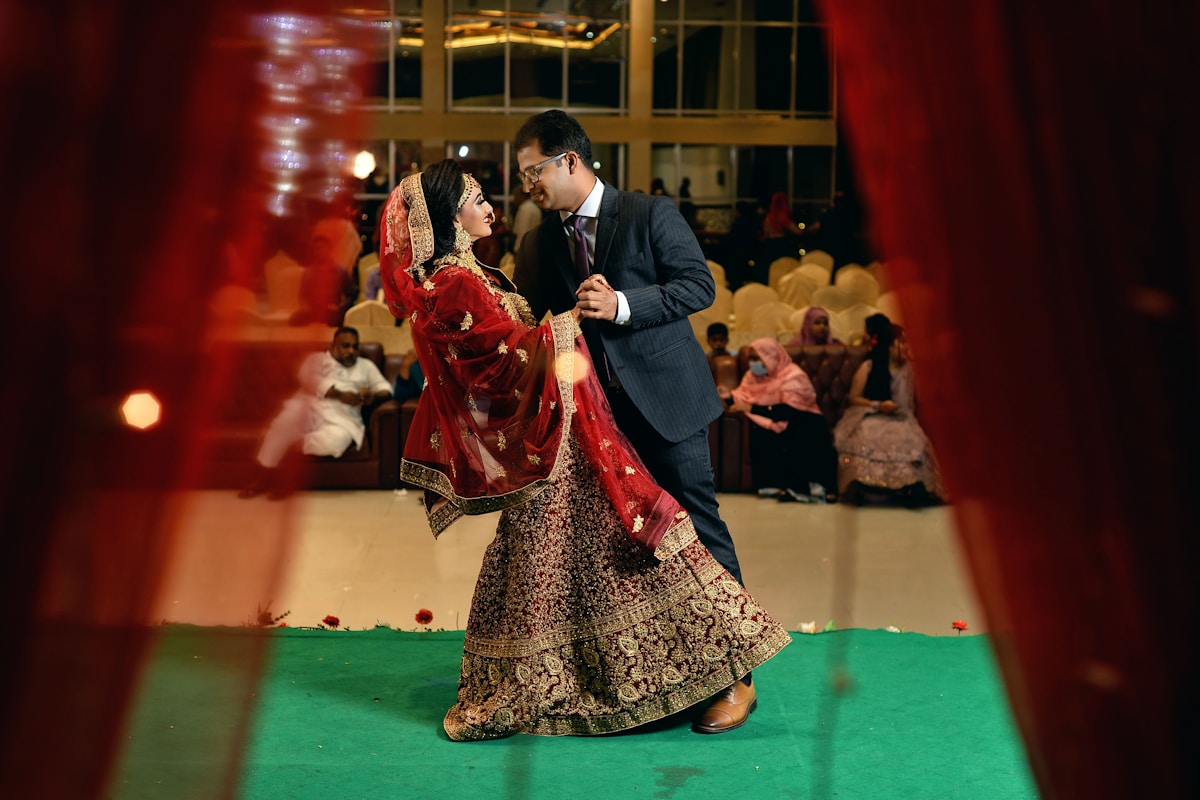
You just got engaged. Congratulations. Now here is what is going to happen: within 48 hours, your mom is going to hand you a list. It might arrive as a voice note. It might be a screenshot of her phone's Notes app. It might be a handwritten page torn from a spiral notebook. But it will arrive. And it will have somewhere between 150 and 400 names on it. Many of them will be people you have never met.
Welcome to South Asian wedding guest list planning. It is not like other wedding planning. Not even close.
Why your guest list is not like other guest lists#
The average American wedding has about 117 guests at a total cost of around $34,200, according to The Knot's 2026 Real Weddings Study, which surveyed 10,474 US couples married in 2025. South Asian weddings routinely land between 300 and 500 guests. In cities with large diaspora communities — think New Jersey, Houston, the Greater Toronto Area, Leicester — 400 is not a big wedding. It is a normal one.
This is not because South Asian families are bad at boundaries (though we will get to that). It is because the fundamental unit of invitation is different.
In most Western weddings, you invite individuals or couples. In South Asian families, you invite family units. Invite one uncle and you have invited his wife, their three kids, and possibly their kids' spouses. Invite one family friend and you have invited their entire household. Your parents' social world is interconnected in a way that makes selective inviting feel less like a practical decision and more like a political statement.
Then there is the multi-event factor. You are not planning one party. You are planning three to seven events over two to five days. Mehndi. Sangeet. Haldi. The ceremony. The reception. Maybe a welcome dinner. Maybe a farewell brunch. Each event has a different guest list, a different vibe, and a different headcount. The mehndi might be 80 people. The reception might be 450. Understanding which events need which guests is half the battle.
The average US wedding hosts 117 guests at a cost of $292 per person (The Knot, 2026 Real Weddings Study). South Asian weddings in the US commonly host 300-500 guests, with per-guest costs ranging from $350-$525 for intimate celebrations and $550-$800+ for traditional multi-event weddings in major metros (Wedding Frontier, 2025; Saathiya, 2025). That math hits differently.
The list from mom (and how to survive it)#
Let us talk about The List. You know the one.
Every South Asian couple has a version of this story. You sit down with your parents to talk about the guest list and they produce a document that looks like a census record. Names are organized by some system only they understand — maybe by which city the family lives in, or by which side of the family they belong to, or by some incident that happened at a wedding in 1997 that determines their invitation priority.
Here is the thing: your parents are not being unreasonable. In many South Asian communities, weddings are reciprocal social obligations. Your parents attended their friends' children's weddings. Those families' parents attended your parents' wedding. Not inviting someone is not just a logistical choice — it can genuinely hurt a relationship that has spanned decades. Your mom is not being dramatic when she says "we have to invite the Sharmas." She might actually be right.
But you also have a budget. And a venue capacity. And a sanity threshold.
Here is what works: treat the conversation as a collaboration, not a negotiation. Instead of starting with "we need to cut this list in half," start with "help me understand who is on this list." Ask your parents to walk you through it. Who are these people? How do they connect to your family? Which ones would genuinely be hurt if they were not there?
What you will usually find is that the list naturally sorts itself into tiers once you start asking questions:
- Must-invite: Close family, family friends with deep reciprocal ties, people whose weddings your parents attended recently
- Should-invite: Extended family you see at major events, long-standing family friends, parents' close colleagues
- Nice-to-invite: Distant connections, people your parents have not spoken to in years, names that are on the list "because they invited us to their daughter's wedding in 2009"
This tiering is not about ranking people's worth. It is about being honest with yourself about venue capacity, budget, and the difference between obligation and genuine connection.
Talk to each set of parents individually before combining lists. Give each side a realistic number ("we can accommodate about 350 total, so roughly 150-175 per side plus our friends"). This avoids the awkward moment where one family's list dwarfs the other, and it gives each side space to make their own tough calls.
Tiering guests across events#
Here is where South Asian weddings get genuinely complicated, and where most generic wedding tools completely fall apart.
Not every guest comes to every event. Your 450-person reception list is not the same as your 100-person mehndi list. The sangeet might be 200 people. The haldi might be 40. You need to track, for each guest, which events they are actually invited to.
A simple way to think about it:
Intimate events (haldi, small mehndi): Immediate family, bridal party, closest friends. These are the people who will smear turmeric on your face and you will not mind.
Medium events (sangeet, larger mehndi): Extended family, close family friends, your own friend group. These are the people who will watch your choreographed dance and cheer loudly.
Large events (ceremony, reception): Everyone. The full list. Your parents' colleagues. Your dad's college roommate who you have met twice. The whole community.
The problem is tracking this. When you have 400 people and five events, you are managing up to 2,000 individual guest-event combinations. That is not a spreadsheet problem. That is a database problem. And unless you enjoy spending your engagement maintaining a database, you need something that handles it for you. (More on this in a bit, or see why spreadsheets fail for multi-event weddings.)
RSVPs: per event, not per wedding#
Here is a mistake almost every couple makes: sending one RSVP for the whole wedding. "Will you attend? Yes or No."
That does not work when you have multiple events. Someone might be a yes for the reception and a no for the sangeet. A family might come to the ceremony but skip the mehndi because they are arriving the day of. Your college friends will definitely be at the reception but are probably not coming to the haldi.
You need RSVPs broken down by event. And you need to make it easy for guests to respond, because here is the uncomfortable truth about South Asian wedding RSVPs: a lot of people simply will not respond at all.
This is not rudeness (usually). It is a cultural norm where attendance is assumed unless someone explicitly says they cannot come. The problem is that caterers and venues need real numbers. You cannot tell your caterer "somewhere between 250 and 400" and expect that to go well.
What helps:
- Send reminders. Multiple ones. Your aunties are busy. They saw your message and meant to respond. They will get to it. They will not get to it unless you remind them.
- Make responding dead simple. A link they can tap on their phone. Not a paper card they need to mail back. Not a login they need to create.
- Give a clear deadline. Industry standard is three to four weeks before the wedding, but for SA weddings with heavy out-of-town and international travel, four to five weeks is safer — your caterer and venue will need a final headcount about two weeks out, and you need a buffer to chase non-responders. "We need your response by March 15th so we can confirm with our caterer" is specific and gives a real reason.
- Accept that some people will just show up. Build a 5-10% buffer into your catering numbers. This is not defeatism. It is experience.
Dietary tracking at actual scale#
At a typical Western wedding, dietary restrictions are the exception. You have a handful of vegetarians, maybe someone who is gluten-free, and you note it on a spreadsheet and move on.
At a South Asian wedding, the default is flipped. A significant portion of your guests — sometimes the majority — will be vegetarian. Many Hindu families are strictly vegetarian. Jain guests will not eat root vegetables (no onion, no garlic, no potatoes). Some families keep halal. Some guests are vegan. Some have allergies.
You are not tracking "exceptions." You are tracking a complex matrix of dietary needs across hundreds of people, and you need to relay that information to your caterer in a way that actually results in the right amount of food being prepared.
Instead of a free-text "any dietary restrictions?" field (which will get you responses ranging from "no carbs" to "I eat everything" to a blank), offer specific options: Vegetarian, Vegan, Jain, Halal, Gluten-Free, Nut Allergy, No Restrictions. You need countable categories that your caterer can work with. And make vegetarian the first option, not the afterthought.
At scale, this matters enormously. If you are feeding 350 people across a sangeet and a reception, the difference between 40% vegetarian and 60% vegetarian is dozens of additional trays of food — and potentially thousands of dollars. Getting accurate dietary data from your RSVPs is not a nice-to-have. It directly affects your budget.
Plus-ones, kids, and the family expectation question#
In Western wedding etiquette, plus-ones follow a fairly standard rule: you offer one to engaged, married, or long-term-partnered guests, and treat single guests case by case. In South Asian families, that framework barely applies, because the assumption is that the whole family is coming.
If you invite Mr. and Mrs. Patel, their two adult children and one grandchild are coming too. That is not a plus-one situation. That is a family unit. Your invitation is to the household.
This can blow up your headcount fast. A list of 100 families can easily mean 350-400 individual guests. You need to think in terms of family units from the start, and you need your tracking system to handle that — knowing that the Mehta family is five people, not one line item.
As for children: in many South Asian families, a "no kids" policy is culturally unusual and can cause real friction. If you do want to limit children at certain events, be explicit and be prepared for some pushback. A common middle ground is allowing kids at the ceremony and reception but keeping the sangeet adults-only.
The budget math that keeps you up at night#
Let us do some real numbers, because this is where guest list decisions stop being abstract and start being financial.
According to The Knot's 2026 study, the average US wedding costs $34,200 for about 117 guests — roughly $292 per person. But that is the average across all weddings. For South Asian weddings in the US, total costs commonly range from $100,000 to $300,000 for 200-500 guests, with per-guest costs between $350 and $800 or more depending on location, number of events, and formality (per Wedding Frontier and My Brown Wedding's 2025/2026 breakdowns).
That means every family unit you add to the list is not just one more name. A family of four at a blended $500 per head (covering their share of catering, bar, decor, and favors across the events they attend) represents $2,000 in additional cost. Ten families like that and you have added $20,000 to your budget without adding a single event, a single decoration, or a single outfit.
This is why the guest list conversation is really a budget conversation. You cannot plan your South Asian wedding budget without knowing your headcount, and you cannot finalize your headcount without understanding what each guest actually costs across every event they attend.
At $400-$600 per guest blended across multiple events, adding just 50 guests to a South Asian wedding can increase total costs by $20,000 to $30,000. This is based on per-guest cost ranges reported by Wedding Frontier and Saathiya (2025) for multi-event celebrations in major US metros, where intimate weddings run $350-$525 per guest and traditional weddings run $550-$800+.
Tools and approaches that actually work#
So what do you do with all of this? You have 400 names, five events, dietary requirements, family units, RSVPs that may or may not arrive, and a budget that depends on all of it.
Spreadsheets are where everyone starts and where most people eventually hit a wall. They work fine up to about 100 guests and one event. Beyond that, you are managing multiple tabs, cross-referencing manually, and praying nobody accidentally deletes a row. If you are already deep in spreadsheet chaos, you are not alone, and there are better options.
Generic wedding apps (The Knot, Zola, WeddingWire) are built for single-event weddings. They assume one ceremony, one reception, one RSVP. They do not handle per-event guest tracking, per-event RSVPs, or the kind of dietary complexity that South Asian weddings require. They are good products — just not built for your wedding.
WhatsApp groups are how half the coordination actually happens in practice, but they are terrible as a system of record. Information gets buried in chat. RSVPs are scattered across five different conversations. Your mom said yes for the Kapoors in a voice note three weeks ago and you have no idea which events that covers.
Purpose-built tools that understand multi-event weddings, per-event RSVPs, family-unit tracking, and dietary management at scale are what you actually need. That is exactly what we built Anvaya to handle — guest management designed from the ground up for weddings with multiple events, hundreds of guests, and two families with opinions. You can track who is invited to which events, collect RSVPs per event, manage dietary needs across your guest list, and see your real headcount at a glance.
Making it all work: a practical approach#
Here is a step-by-step approach that has worked for hundreds of couples:
1. Start with the non-negotiables. Immediate family on both sides. Your own close friends. The people who, if they were not there, the wedding would feel wrong. Write those down first.
2. Have the parent conversations. Give each side a number. Be honest about budget constraints. Ask them to tier their own lists. Let them make their own hard choices rather than you making those choices for them.
3. Build your event matrix. Map out which events exist, which guests go to which events, and what the capacity is for each venue. This is the structural backbone of your entire plan.
4. Set up per-event RSVPs early. Do not wait until two months before the wedding. Send save-the-dates with a link to RSVP by event. Give people time. Send reminders.
5. Track dietary needs from the start. Build it into your RSVP flow. Do not try to collect this information separately — you will lose it.
6. Revisit the numbers monthly. Guest lists are living documents. People get added. People drop off. Families grow. Budgets shift. Check your numbers against your budget regularly so there are no surprises.
7. Build in a buffer. For catering, plan for 5-10% more guests than your confirmed RSVPs. For budget, keep a contingency line item for guest list creep. Both will save you stress.
The emotional part nobody talks about#
Guest list planning is not just logistics. It is emotional. It touches on family dynamics, cultural identity, generational expectations, and the tension between the wedding you want and the wedding your family envisions.
There will be moments where you feel frustrated that you cannot just invite your 80 closest people and call it a day. There will be moments where your parents feel hurt that you want to cut someone they care about. There will be moments where you and your partner disagree about whose side gets more seats.
All of that is normal. All of that is part of planning a South Asian wedding. The goal is not to eliminate the complexity — it is to manage it in a way that does not consume your entire engagement.
Get the logistics right, and you free up space for what actually matters: celebrating with the people you love, in a way that honors where you come from and where you are going.
That is what a good guest list gives you. Not perfection. Just a really good party with the right people in the room.
Ready to simplify your wedding planning?
Anvaya is built for South Asian weddings — manage every event, every guest, and every vendor in one place.
Get Started Free