A Complete Guide to South Asian Wedding Events: From Mehndi to Reception
If you grew up attending South Asian weddings, you probably remember a blur of color, music, too much food, and events that seemed to go on forever. You knew there was a mehndi and a sangeet and a ceremony and a reception, but the lines between them were fuzzy. Someone told you when to show up. You showed up.
Now you're planning your own wedding, and suddenly you need to actually understand what each event is, why it exists, and whether you can skip the ones that don't feel like you.
This guide is for you. Whether you're a second-gen couple trying to honor your family's traditions without blindly following rituals you don't understand, or you're a non-SA partner trying to figure out what on earth a baraat is, we'll walk through every major South Asian wedding event with honesty and zero judgment.
One thing to know upfront: there is no single "South Asian wedding." A Tamil wedding and a Punjabi wedding share about as much DNA as a New Orleans wedding and an Amish one. Regional, religious, and family traditions vary enormously. What we're covering here are the most common events you'll encounter, but your version might look completely different, and that's fine.
If you're still in the early stages, our South Asian wedding timeline guide covers when to start planning each of these events.
Roka, Tilak, and Sagai (Engagement)#
Long before the wedding week, most North Indian families hold one or more engagement-stage events. These often happen six months to a year ahead of the wedding and are easy to underestimate when you're planning.
- Roka is the first formal step — the two families publicly accept the match. Small, intimate, usually at one family's home. Tilak applied, sweets fed, blessings given. No rings required.
- Tilak is a groom-side ceremony where the bride's father and male relatives visit the groom's home, apply a vermilion mark to his forehead, and present gifts. More common in Punjabi, UP, and Bihari families.
- Sagai (or Mangni) is the formal engagement: ring exchange, often a larger event with extended family, sometimes blended with the tilak.
Some families collapse all three into one event; others keep them as three separate gatherings months apart. South Indian and Pakistani families have parallel traditions (nischayathartham, mangni) with their own ritual structure.
Mehndi / Henna#
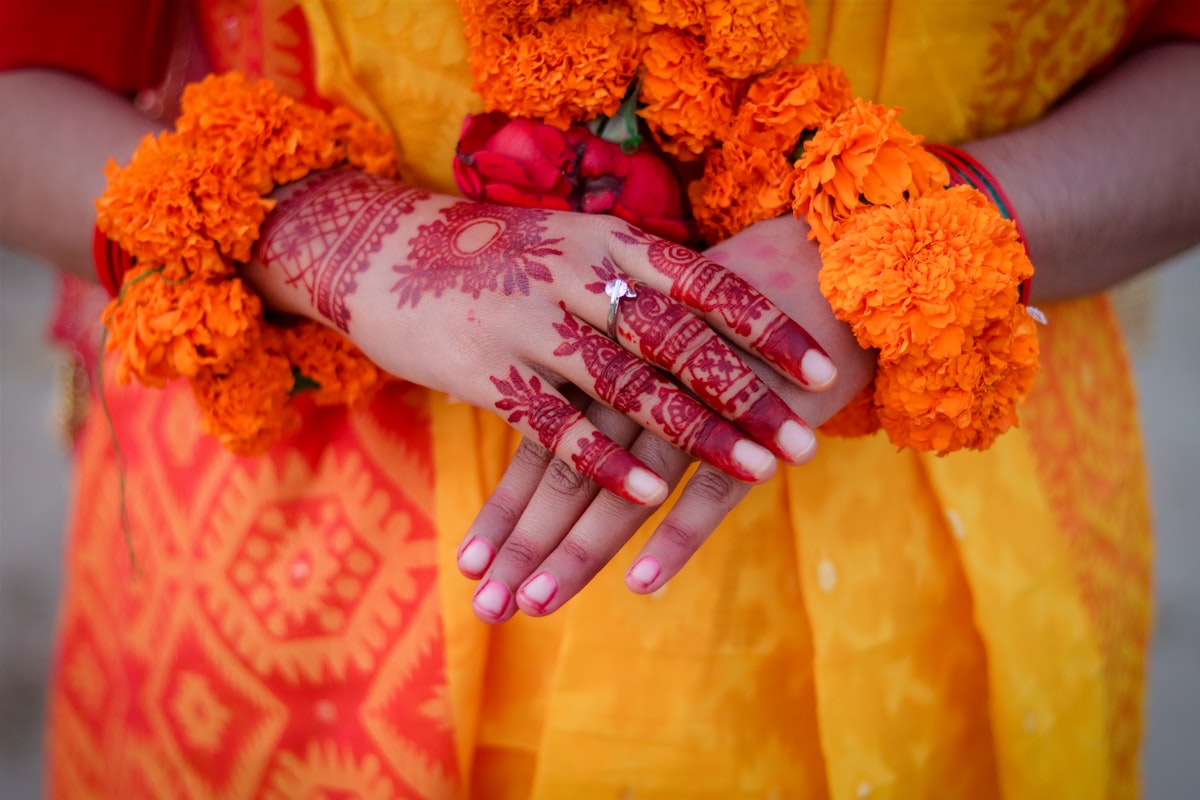
The mehndi is one of the most intimate, relaxed events in a South Asian wedding. Traditionally hosted by the bride's side, it's centered around the application of henna (mehndi) — intricate temporary designs painted onto the bride's hands and feet, and often onto the hands of close female family members and friends.
What actually happens
A mehndi artist (or a team of artists, for larger events) sets up and works through guests one by one. The bride's mehndi is the most elaborate and can take two to four hours on its own. Meanwhile, everyone else eats, talks, listens to music, and generally hangs out. Some families make it a full party with a DJ or live dholak players. Others keep it quiet — think afternoon tea with henna.
The practical details
Expect anywhere from 50 to 150 guests, though some families go smaller and some go much bigger. You'll need a mehndi artist (book early — the good ones get snapped up months ahead), seating that works for people sitting still for 30-plus minutes, food, and music if you want it. The mehndi typically happens one to three days before the wedding ceremony.
What's negotiable
The mehndi is almost always included in some form, but the scale is up to you. Some couples fold it into the sangeet to save a day. Others keep it tiny and women-only, which is the more traditional approach. The groom having mehndi applied is increasingly common but still optional depending on your family's tradition.
For a deep dive into planning this event — from finding the right artist to managing the schedule — see our complete mehndi ceremony planning guide.
Sangeet#
If the mehndi is the intimate gathering, the sangeet is the party. The word comes from Sanskrit and roughly translates to "sung together" — and that's exactly what this event is about: music, dance, and celebration.
What actually happens
The sangeet is essentially a talent show crossed with a dance party. Family members and friends from both sides prepare choreographed dance performances, often rehearsed for weeks or months. Think Bollywood numbers, funny skits about the couple, and that one uncle who insists on singing. There's usually a DJ or live band, a dance floor, and a lot of food. Some sangeets are casual and backyard-style; others rival the reception in production value.
The practical details
Guest counts range widely — 100 to 300 is common, but it depends on whether you're treating it as a major event or a more casual gathering. You'll need a venue with a stage or performance area, sound equipment, and enough space for dancing. Plan for two to four hours. The sangeet usually happens the night before the wedding or two nights before if you have a three-day celebration.
The biggest planning challenge is choreography coordination. If you have eight dance groups all wanting rehearsal time, that's a logistical puzzle. Some couples hire a choreographer to help; others let each group figure it out.
What's negotiable
The sangeet is beloved but not religiously required. Some couples skip formal performances entirely and just throw a party. Others combine the sangeet and mehndi into one event. If your families are small or not into performing, a casual music night works just as well.
If you are planning a sangeet, our sangeet night planning guide covers everything from choreography coordination to sound equipment.
If you're considering merging these two events to save a day, plan for the mehndi to happen in the afternoon with the sangeet starting in the evening. This gives the henna time to set while keeping the energy high for performances later.
Haldi / Pithi#
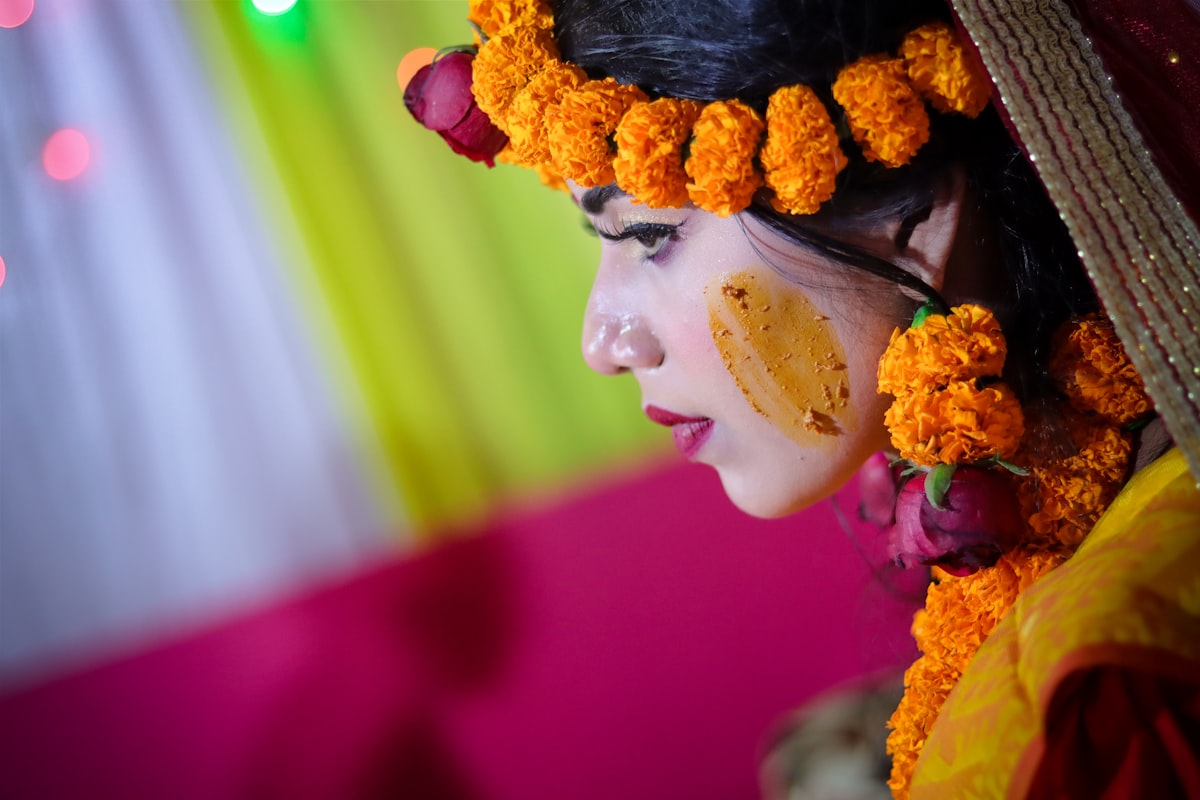
The haldi (also called pithi in some communities) is a turmeric ceremony where a paste of turmeric, sandalwood, and other ingredients is applied to the bride's and groom's skin. It's meant to purify and bless them before the wedding, and it's also supposed to give you that pre-wedding glow.
What actually happens
Close family members take turns smearing turmeric paste on the bride or groom (sometimes both, sometimes separately). It's messy, it's fun, and it stains everything yellow. Wear clothes you don't care about. The mood is playful and emotional — this is usually one of the smaller, more intimate events, and it's often when the happy tears start flowing.
The practical details
Haldi ceremonies are typically small — 20 to 50 people, mostly close family. They usually happen the morning of the wedding or the day before. You'll need the turmeric paste (family recipes vary), a designated area that can handle the mess, and towels. Lots of towels.
What's negotiable
This is one of the events couples most often ask about skipping. "Do we need the haldi?" Honestly, it depends on your family. For many, it's a deeply meaningful ritual. For others, it's optional. If you're not sure, talk to your parents. And if you do it, lean into the mess — the photos are always worth it.
For tips on setup, what to wear, and how to keep things running smoothly, check out our haldi ceremony planning guide.
The haldi stains everything it touches — and turmeric yellow does not wash out easily. Have guests wear white or yellow clothes they don't mind staining, and keep the bridal outfit for the ceremony far away from the turmeric zone.
Garba / Raas#
If you're Gujarati, you already know. Garba and raas are traditional folk dances performed in concentric circles, usually with dandiya sticks (those colorful wooden sticks you clap together). It's high energy, incredibly fun, and one of the most participatory events in any South Asian wedding.
What actually happens
Guests dance in circles to live or recorded garba music. There's usually a progression from slower, traditional garba to faster, more competitive raas rounds. Everyone participates — this isn't a spectator event. Expect the energy of a dance party but with actual choreography that most of the Gujarati guests already know.
The practical details
Garba can be combined with the sangeet or held as a separate event. Guest counts are similar to the sangeet — 100 to 300 people. You'll need a large open space (dance floor), music, and dandiya sticks if you're doing raas. Some couples hire a garba DJ who specializes in the right music progression.
What's negotiable
Garba is primarily a Gujarati tradition, though it's become popular across South Asian communities. If it's part of your culture, your family will probably expect it. If it's not, no one will be confused by its absence.
Baraat#
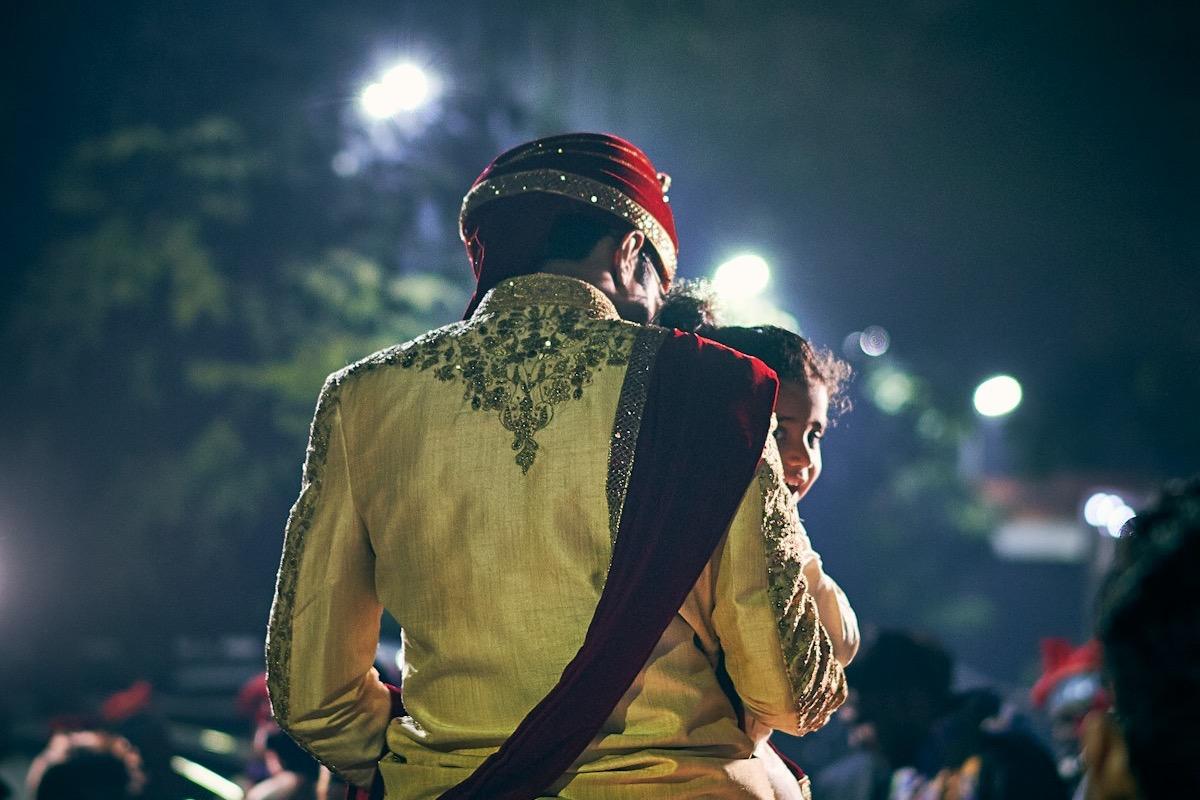
The baraat is the groom's procession to the wedding venue, and it is exactly as dramatic as it sounds. The groom arrives on a decorated horse (or in a luxury car, or occasionally on an elephant), accompanied by his family and friends, all dancing in the street to the beat of a dhol.
What actually happens
The groom's party gathers at a designated starting point — a parking lot, a street corner, the hotel lobby — and processes toward the venue. A dhol player (or two, or three) leads the way. Everyone dances. The groom sits on the horse looking regal while his friends and cousins go absolutely wild around him. When the baraat reaches the venue, the bride's family greets them with a short welcoming ceremony.
The whole thing takes 20 to 45 minutes and is one of the most photographed parts of any South Asian wedding.
The practical details
You'll need a dhol player (book early), a horse if you want one (and check venue restrictions — many don't allow horses), and street or parking lot space for the procession. Check with your local municipality about noise ordinances and road permits if you're processing on a public street. Guest count is usually the groom's full guest list, though only the young and energetic actually dance.
What's negotiable
The horse is optional — many grooms arrive in a decorated car or just walk with the procession. The dhol is pretty standard, but the scale of the baraat is flexible. Some are 200-person street parties; others are a quick, fun walk from the parking lot to the door.
Hindu Wedding Ceremony#
This is the main event for Hindu weddings, and it's also the one that causes the most planning stress. Traditional Hindu ceremonies can run two to five hours. Most modern couples aim for 45 minutes to an hour. Your pandit will have opinions about this.
What actually happens
The ceremony takes place under a mandap — a decorated canopy or structure — with a sacred fire (agni) at the center. The core rituals include:
- Jaimala (garland exchange): The bride and groom exchange flower garlands, symbolizing mutual acceptance. This is often playful, with each side lifting their person higher so the other can't reach.
- Kanyadaan: Traditionally, the father "gives away" the bride. This is one of the more debated rituals — some couples modify it, some skip it, some reinterpret it as a blessing rather than a "giving."
- Pheras and Saptapadi: The couple circles the sacred fire (clockwise, keeping the fire on their right) — four rounds in many North Indian traditions, seven in others. They then take seven steps together (the Saptapadi), each step representing a vow: food and nourishment, strength, wealth and prosperity, happiness, progeny, health through the seasons, and lifelong friendship. The Saptapadi is the spiritual and, under the Hindu Marriage Act §7, often the legal core of the ceremony.
- Sindoor and mangalsutra: The groom applies sindoor (vermillion) to the bride's hair parting and ties a mangalsutra (sacred necklace) around her neck.
- Vidaai (farewell): After the ceremony, the bride formally leaves her parental home with her new husband. She tosses rice and coins backward over her head as a symbolic thank-you to her parents, and her brothers and cousins traditionally push the car as she leaves. This is almost always the most emotional moment of the day — make sure your photographer is positioned for it.
The practical details
You'll need a pandit (Hindu priest) who matches your regional tradition and language, a mandap, a sacred fire setup (check venue fire codes — some venues require a contained flame or electric alternative), and seating for your full guest list. Guest counts for the ceremony match the overall wedding size, typically 150 to 500 people.
Here's the thing nobody tells you: there is no single "Hindu ceremony." A Tamil Brahmin wedding has rituals a Punjabi wedding doesn't — the kashi yatra, where the groom mock-renounces the world to walk to Kashi as a sanyasi and the bride's father playfully convinces him to marry instead; the oonjal, where the couple is seated on a decorated swing while elders feed them milk and bananas; and the thali kettu (or maangalya dharanam), where the groom ties a sacred thali necklace around the bride's neck — the South Indian counterpart to mangalsutra. A Bengali wedding has its own entirely distinct set of rituals (shubho drishti, sindoor daan under a chadar). "My pandit said X" and "My mom's pandit said Y" is a real and common conflict, especially in cross-regional matches. Discuss the ceremony structure early and often.
What's negotiable
Ceremony length is the biggest negotiation point. Traditional pandits may push for the full set of rituals. Many couples work with their pandit to identify the essential rituals and trim the rest, getting the ceremony down to 60 to 90 minutes. Some rituals, like kanyadaan, are increasingly modified or replaced with alternatives that feel more aligned with modern values.
If you're not religious but your family is, have an honest conversation. Many pandits are open to explaining each ritual to guests as it happens, which makes the ceremony meaningful even if you're not personally observant. Ceremony programs for non-SA guests go a long way — your friends want to understand what's happening, and a simple printed guide helps enormously.
For more on managing the budget across all these events, check out our South Asian wedding cost breakdown for 2026.
Sikh Wedding Ceremony (Anand Karaj)#
The Anand Karaj, meaning "blissful union," is the Sikh wedding ceremony. It takes place in a gurdwara (Sikh temple) in the presence of the Guru Granth Sahib, the Sikh holy scripture.
What actually happens
The ceremony centers on four Laavan — four hymns from the Guru Granth Sahib composed by Guru Ram Das. The couple circles the holy scripture four times in clockwise procession, once per Laav, with the groom leading and the bride following him while holding one end of a palla (a long scarf draped over the groom's shoulder, with the other end placed in the bride's hand by her father). Each Laav represents a stage of spiritual union — commitment to righteous living, growing devotion, overcoming ego, and final blissful union with the Divine.
The ceremony also includes kirtan (devotional singing), ardas (prayer), and the sharing of karah prasad (sacred sweet). The entire congregation sits on the floor as a sign of equality.
The practical details
Anand Karaj ceremonies are held in gurdwaras and the langar (community meal) afterward is famously open to anyone, regardless of faith. The ceremony itself, though, is governed by the Sikh Rehat Maryada — many gurdwaras require both partners to be Sikh, and rules vary widely between gurdwaras and jurisdictions. The ceremony runs about one to two hours. Head coverings are required for all guests, and shoes are removed before entering.
Guest counts vary widely. The gurdwara ceremony itself might have 200 to 500 attendees, with the reception as a separate event.
What's negotiable
The Anand Karaj itself has a fairly fixed structure dictated by Sikh religious authority. However, many couples hold additional events (sangeet, reception) with more flexibility. If you're having an interfaith wedding, know that some gurdwaras have specific requirements about both partners' involvement — discuss this with the granthi (priest) early.
Muslim Wedding Ceremony (Nikah)#
The nikah is the Islamic marriage contract, and compared to some other South Asian ceremonies, it's relatively brief and legally focused. That said, the surrounding celebrations can be as elaborate as any wedding.
What actually happens
The core of a nikah involves:
- Mahr: A gift (often monetary) from the groom to the bride, agreed upon before the ceremony. This is the bride's right and is taken seriously.
- The proposal and acceptance: In the presence of an imam and witnesses, the groom proposes and the bride accepts. The famous "Qubool Hai" ("I accept") is traditionally spoken three times by each party in South Asian custom — though Islamic law requires only one clear, witnessed acceptance for the nikah to be valid.
- Signing the marriage contract (nikahnama): The legal document is signed by the couple and witnesses.
- Khutbah: The imam delivers a sermon with Quranic verses about marriage.
The practical details
A nikah can be performed at a mosque, at home, or at a wedding venue — there's more flexibility in location than many people assume. The ceremony itself can be as short as 15 to 30 minutes. Witnesses (typically two from each side) are required. Guest counts for the nikah portion vary, but 50 to 200 is common. The walima (reception feast) usually follows, either the same day or the next.
What's negotiable
The nikah structure is religiously prescribed, but the scale and setting are flexible. Some families hold a simple nikah at home with close family and then throw a large walima. Others make the nikah itself a grand event. The mahr amount is private and agreed upon by the couple. Pakistani, Bangladeshi, and Indian Muslim weddings each have their own additional cultural traditions beyond the nikah itself.
Walima (the marriage feast)#
The walima is the post-nikah celebration hosted by the groom's family — religiously encouraged in Islam as a public announcement of the marriage. Pakistani and Indian Muslim weddings almost always include one, usually the day after the nikah/baraat or within the first week. It's the equivalent of a reception in scale and energy: 300+ guests, dinner, music (in some traditions), and the couple as the centerpiece.
Mayun and pre-wedding Pakistani events#
In Pakistani weddings, the run-up to the nikah typically includes a dholki (informal singing nights), a mayun (the bride is "secluded" at home a few days before the wedding while ubtan — a turmeric/sandalwood paste — is applied for skin glow, with yellow as the day's color), and a mehndi night (often two separate events for the bride's and groom's sides). Bangladeshi weddings have parallel traditions (gaye holud) with their own naming and structure.
Reception#
The reception is the universal event — every South Asian wedding has some version of it, regardless of religion or region. It's the big party.
What actually happens
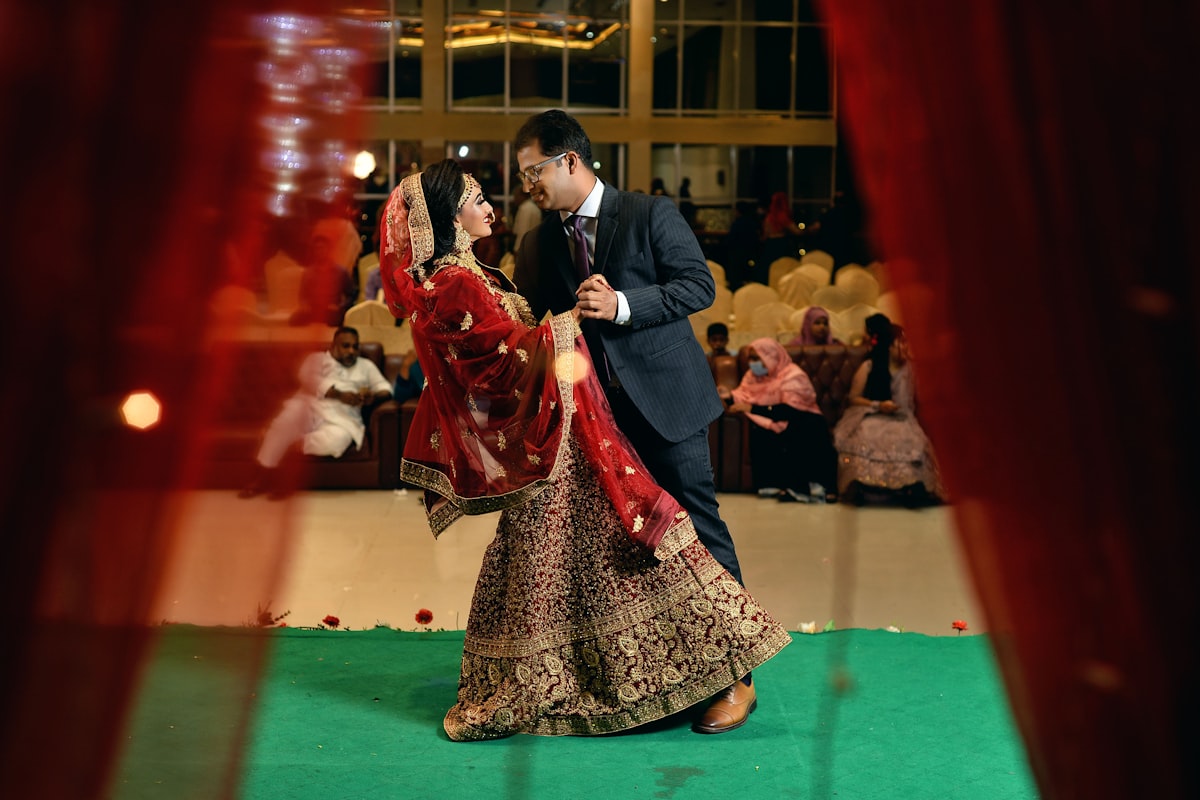
The reception is the most "Western" of South Asian wedding events. There's dinner (usually a buffet, because South Asian wedding food deserves space to spread out), speeches and toasts, a first dance (increasingly common), and dancing. Some receptions include a formal entrance for the couple, cake cutting, and other familiar reception traditions blended with South Asian elements.
The practical details
The reception is typically the largest event by guest count — 200 to 600 guests is common, though some weddings push well beyond that. You'll need a venue, catering (plan for vegetarian and non-vegetarian options at minimum), a DJ or band, decor, and a timeline that keeps things moving. Receptions usually run three to five hours.
What's negotiable
Almost everything. The reception is where couples have the most freedom to make the event their own. Skip the first dance if it's not your thing. Do a dessert bar instead of a cake. Have a live band instead of a DJ. The reception is yours.
Grah Pravesh and Satyanarayan Puja (Post-Wedding)#
Two rituals close out a traditional Hindu wedding after the reception.
Grah Pravesh is the bride's formal first entry into her in-laws' home. She's welcomed at the threshold with an aarti, and in many traditions she gently kicks over a small kalash of rice placed at the door — symbolizing prosperity flowing into the home. Small, family-only, and usually emotional.
Satyanarayan Puja is performed by the newlyweds at the groom's home, often the day after the wedding or within the first week. The couple fasts until the puja is complete, and family and close friends are invited for the ceremony and the feast that follows. It's the spiritual closing bracket of the wedding.
Both are typically intimate, family-only events — but if your families come from regions where these are non-negotiable, build them into your post-wedding day timeline before you book a honeymoon flight that leaves at 6 AM the next morning.
Which Events Do You Actually Need?#
This is the question every couple asks and very few wedding guides answer honestly. So here it is.
The only truly required event is your religious or legal ceremony. Everything else is cultural tradition, family expectation, or personal preference. That's not to say the other events don't matter — they absolutely do, and many couples find deep meaning in all of them. But if you're feeling overwhelmed by a five-day celebration and wondering what you can cut, here's a framework.
Start with what's meaningful to you. If the haldi makes you cry happy tears thinking about your mom applying turmeric to your face, keep it. If it feels like an obligation, it's okay to let it go.
Talk to your parents early. For many South Asian families, certain events are non-negotiable — not because of religion, but because of family expectation and community norms. Understanding which events matter most to your families (and why) helps you make informed choices rather than reactive ones.
Consider combining events. Mehndi and sangeet are frequently combined. Haldi can happen the morning of the ceremony rather than as a separate event. Garba can fold into the sangeet. Combining events saves money, time, and energy without eliminating traditions.
Be honest about your budget and energy. A multi-day South Asian wedding is a marathon, not a sprint. If you're already struggling to track costs across multiple events, simplifying your event schedule is a legitimate strategy. Three well-planned events will always be better than five exhausting ones.
For interfaith couples — Hindu-Christian, Hindu-Sikh, Hindu-Muslim, or any other combination — the question of which events to include gets more complex. The best approach is usually to honor both traditions rather than trying to merge them into one ceremony. Two separate ceremonies (even on the same day) tend to feel more authentic than one hybrid ceremony that satisfies no one.
Planning Across Multiple Events#
Here's the part that catches most couples off guard: it's not any single event that makes a South Asian wedding hard to plan. It's managing all of them together. Each event has its own venue, guest list, vendors, timeline, and budget. Your spreadsheet will fail you around event three.
Vendor coordination across multiple days is its own challenge — your photographer needs to know the schedule for every event, your florist might be doing different setups for the mehndi and the ceremony, and your caterer is handling different menus for different nights. Our guide on choosing vendors for multi-day celebrations covers this in detail.
This is actually why we built Anvaya with ceremony-specific event templates. Instead of cramming a five-day celebration into a single planning tool designed for one-day weddings, you can plan each event separately with its own guest list, vendor assignments, budget tracking, and timeline. Because a mehndi and a reception are fundamentally different events that deserve their own planning space.
Every South Asian wedding is unique, shaped by religion, region, family, and the couple at the center of it. There's no single right way to do this. Whether you're planning a traditional five-day celebration or a streamlined two-day affair, the best wedding is one where you understand why you're doing what you're doing and you actually enjoy it.
Your guests will remember the love, the food, and the dancing. Everything else is details.
Continue Reading
How to Plan Your Mehndi Ceremony: A Complete Guide
Everything you need to know about planning your mehndi — from finding the right artist and setting up the space to managing guests and keeping the schedule on track.
How to Plan Your Haldi Ceremony: A Complete Guide
The haldi is one of the most joyful, colorful events of a South Asian wedding. Here is how to plan it — from turmeric prep and dress code to venue setup and photography.
How to Plan Your Sangeet Night: A Complete Guide
From choreography and DJ setup to venue logistics and food — your practical guide to throwing a sangeet night your guests will actually remember.
Ready to simplify your wedding planning?
Anvaya is built for South Asian weddings — manage every event, every guest, and every vendor in one place.
Get Started Free