WEDDING CHECKLIST
A checklist that knows your wedding is six functions, not one.
Mehndi, sangeet, haldi, the ceremony, the reception. Tag every task to the function it belongs to, due-date it back from your wedding day, and hand it to the family member actually doing the work.
Free during early access. No credit card.
- Start
- 6 tasks waiting the day you create your wedding
- Owners
- Assign each task to a named family member
- Read it
- List, timeline, or calendar with .ics export
WHY GENERIC CHECKLISTS FAIL
A South Asian wedding is six weddings stacked on one weekend.
General checklists start from a one-ceremony model
Most wedding timelines start with engagement party, then shower, then rehearsal dinner, then ceremony, then reception. A desi plan has a different task spine: mehndi artist, sangeet performances, haldi logistics, baraat route, panditji brief, muhurat timing, and per-event catering. Anvaya starts from those ceremonies instead of making you retrofit them into a generic timeline.
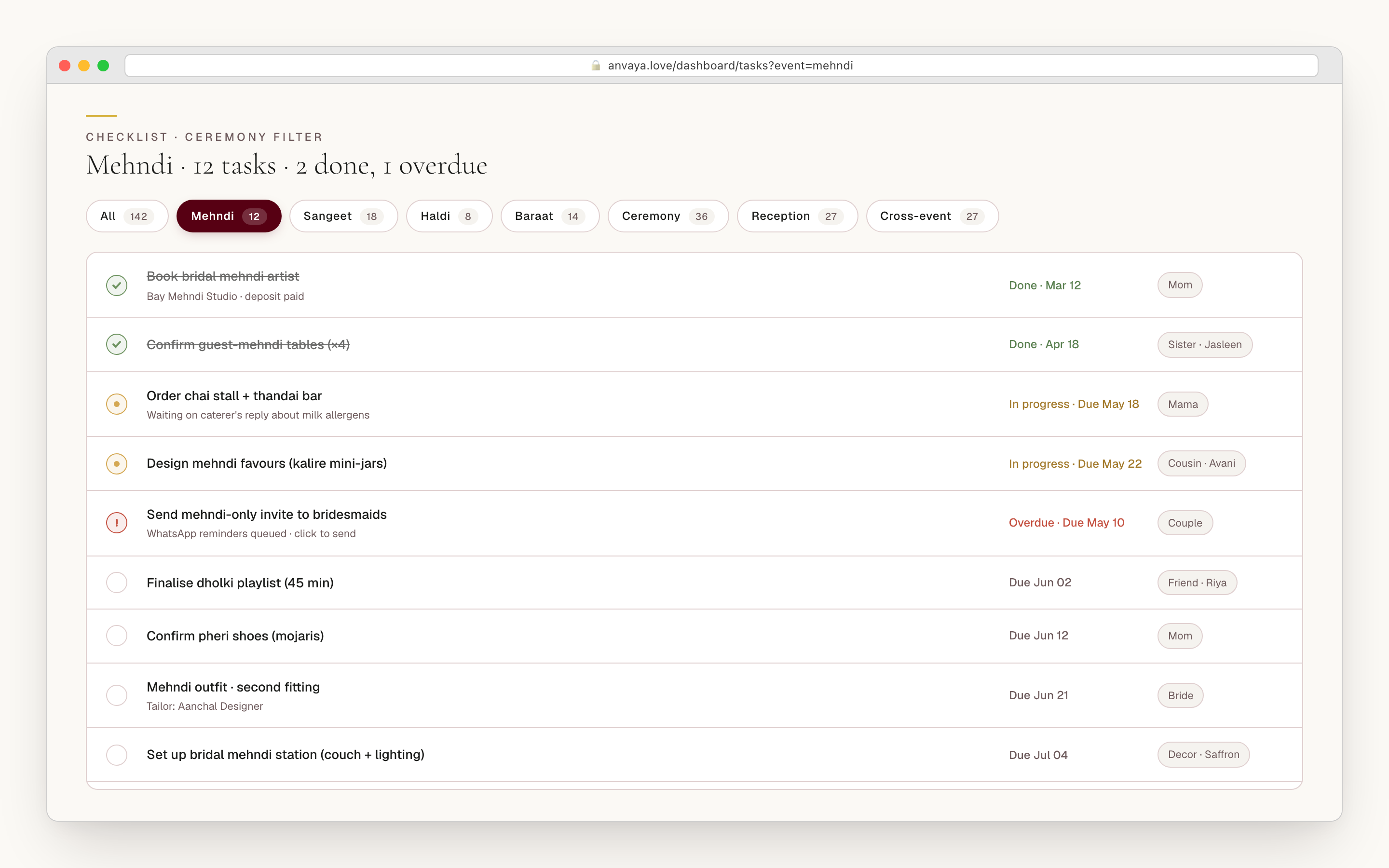
Tasks aren't tagged by ceremony — you can't filter 'mehndi due'
A generic checklist gives you 400 tasks in one long list with no way to ask 'what is due for the sangeet this month' or 'what does the haldi still need.' For a multi-event wedding, that flat list is unusable — by month three you cannot tell what you have actually finished for each function because everything is dumped into the same column.
Delegation is unclear — mom does X, mama does Y, sister does Z
A desi wedding is a family project, not a couple's project. Your mother is calling caterers, your mother-in-law is arranging the trousseau, the bride's chacha is coordinating baraat logistics, two cousins are running the sangeet performance, and a friend is editing the welcome video. With no shared list, every owner runs their own spreadsheet and the dependencies break silently.
Everything looks urgent, so nothing is
A list of 300 unfinished tasks does not tell you what to do on a Tuesday night. You have done 200 things; the photographer is booked; the venue is locked; should you be panicking that the invitation designer has not started? Anvaya due-dates every task backwards from your wedding day, flags what is overdue and what lands this week, and lets you filter the board to one ceremony or one owner — so the next move is obvious instead of buried.
BUILT FOR EVERY FUNCTION
Tag every task to the function it belongs to.
A South Asian wedding is not one event with a rehearsal dinner the night before. It is a run of distinct functions, each with its own guests, vendors, attire, music, and food. Anvaya ships twelve built in — mehndi, sangeet, haldi, baraat, a welcome party, the wedding, the reception, plus nikah, walima, Anand Karaj, a church ceremony, and chuppah & ketubah — each arriving with a name, a typical duration, and a dress code already filled in. You add them in a couple of taps and start tagging tasks, not building templates from scratch.
Every task carries the one function it belongs to. So instead of 400 to-dos in a single column, you ask the board a real question and get a real answer: what is still open for the mehndi, what does the haldi need this week. One click on the event filter narrows the whole checklist to that function and hides everything else — the difference between a list you can act on and a list you scroll past.
Anything the twelve templates do not name — a post-wedding brunch, a Tamil muhurtham, a separate ladies' sangeet — you add as your own custom event, give it a date and a venue, and tag its tasks to it exactly like the built-in ones. Each function also carries its own RSVP per guest, so the headcount you chase for the sangeet is not the headcount you chase for the reception.
- Twelve event templates built in — mehndi, sangeet, haldi, baraat, welcome party, wedding, reception, nikah, walima, Anand Karaj, church, chuppah
- Add a post-wedding brunch, a muhurtham, or any other function as a custom event
- Every task is tagged to one function — filter the whole board to it in a click
- Each function carries its own date, venue, dress code, and a separate RSVP per guest
It is not a blank page the day you start.
The moment you create your wedding, six tasks are already waiting — set the budget, decide the guest-list size, book the venue, choose the dates, book the photographer, send the save-the-dates. No empty screen, no “where do I even begin.” You open the planner to work already in motion.
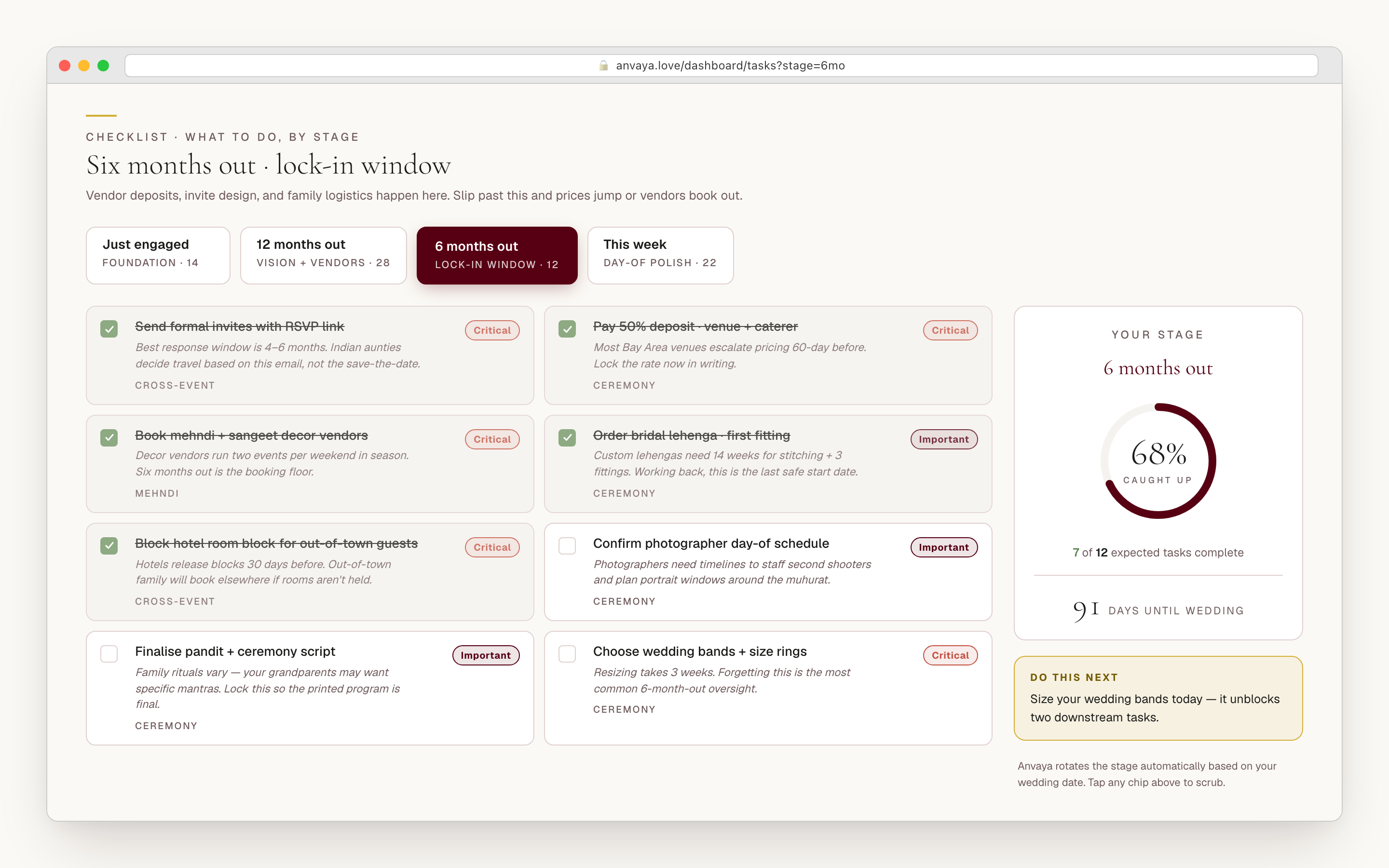
When you want the rest, the seed dialog reads how far out your wedding is and pre-checks the tasks for your stage — Early (12+ months out), Active (3 to 12 months), or the final stretch. There are 23 templates in all, each with a due date anchored back from your wedding day, so a task that should happen nine months out lands nine months out — not whenever you happen to add it.
Then read the checklist however the moment calls for. The list is the working view you live in. The timeline lays every task out month by month so you can see the whole runway. The calendar drops due dates onto the grid and exports the visible month as an .ics file for Google Calendar, Apple Calendar, or Outlook. Same checklist, three ways to read it.
- Six starter tasks waiting the moment you create your wedding
- 23 templates in all — the seed dialog pre-checks the ones for your stage
- Due dates anchored back from the wedding day, not from when you added them
- Read it as a list, a month-by-month timeline, or a calendar with .ics export
A South Asian wedding plans backwards from the date.
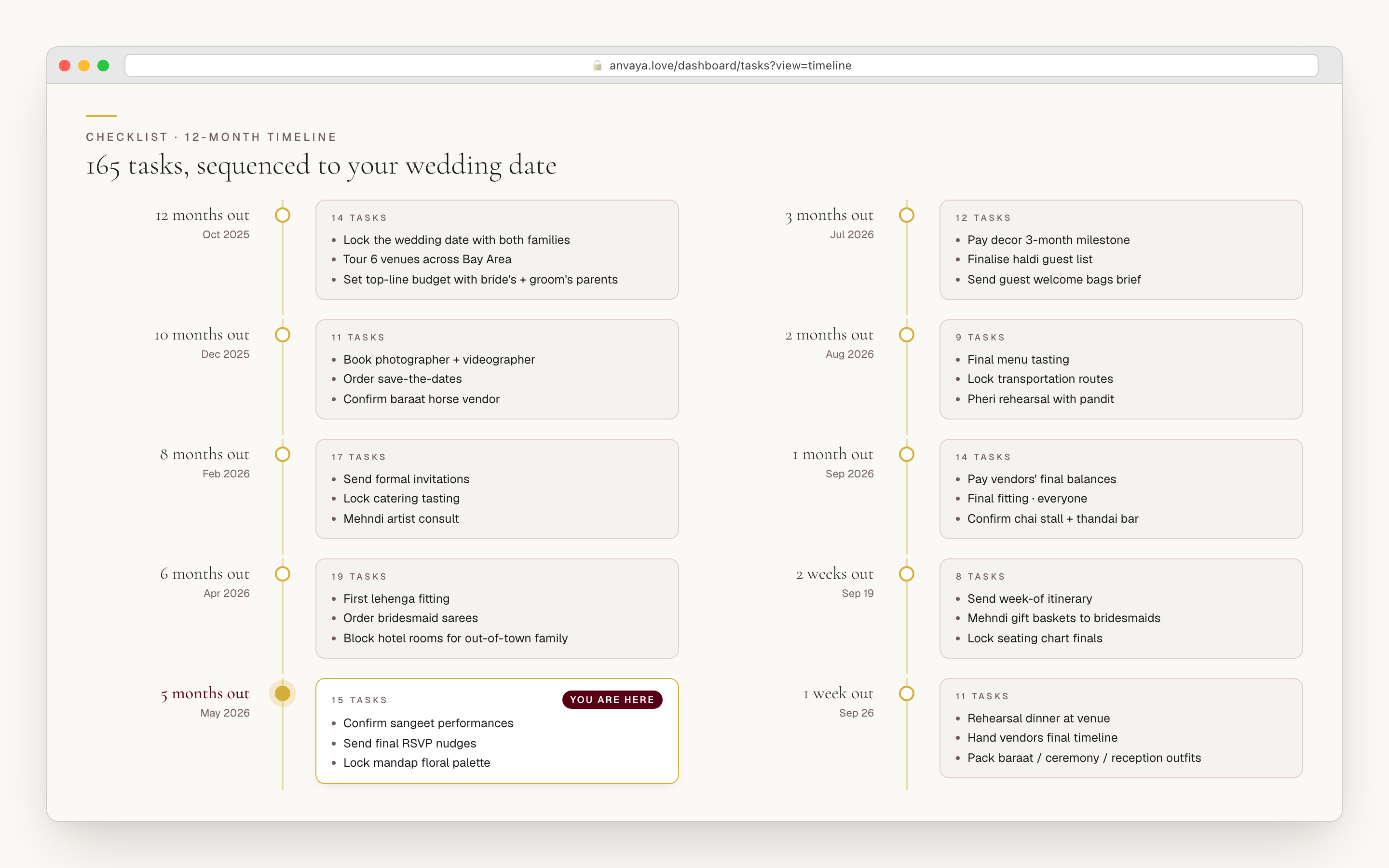
The timeline view lays the whole runway out month by month. Here is the shape of a full multi-event wedding, from the day you lock the date to the morning the baraat steps off — the milestones Anvaya seeds, anchored to your wedding day so each one lands when it actually needs to.
12 months out — foundations. Book the venues first; for a 400-guest reception in a major US or UK metro, the rooms that hold that many people are gone 12–18 months out. Hire a multi-event planner who has seated a baraat before, then lock the desi-fluent photographer and videographer. Choose the decor lead and mandap fabricator, build the working budget with a line per ceremony, and start both guest lists — for 400 guests they take three months to stabilise.
9 months out — vendors and save-the-dates. The best caterers and mehndi artists in any metro are locked 9–12 months out for a peak-season Saturday. Reserve the baraat horse and handler, hire the invitation designer, and send save-the-dates — 8–12 months ahead for a destination wedding (Mexico, Italy, India), since roughly a third of US weddings are now destination affairs (per The Knot's 2024 Real Weddings Study). Anvaya's digital save-the-date goes out by email or a shareable link and carries guests straight to your wedding site.
6 months out — outfits and RSVP go-live. The website goes live and the per-event RSVPs start coming back. The bride's lehenga needs four to six months of fittings; the sangeet, mehndi, and reception outfits follow, and the parents and siblings need theirs coordinated across all four events. Make each outfit a task, assign it to its owner, and the seven people each ordering three outfits can filter the board to their own list and nothing else. Open the hotel block and arrange transport per ceremony.
3 months out — invitations and ceremony detail. Invitations go in the mail. Confirm the panditji's muhurat and lock the ceremony script — gathbandhan and kanyadaan for a Hindu wedding; the four lavaan and langar for a Sikh one; the imam, witnesses, and mahr for a Muslim nikah. A generic checklist cannot ask these; you cannot miss them. Second fittings run, jewellery gets pulled, and caterer taste tests capture dietary notes — Jain, halal, vegan, gluten-free — against each guest, per event.
1 month out — final counts. Counts go to every caterer. Because each guest carries a separate RSVP and a separate dietary note per event, the confirmed headcount for the mehndi, the sangeet, and the reception each rolls up on its own — you pull a real per-event count straight from the guest list instead of reconciling four spreadsheets the week it is due. Pay midpoint vendor milestones and brief the baraat lead on the route and the horse.
Week of — the operation runs. Get the order of events to every vendor and both families; each person needs only the slice that touches them. Sangeet performers do a dress rehearsal three days out, the ceremony rehearsal runs the day before, and the parents get briefed on who they are greeting at which function. Make each briefing a task, assign it to the family lead who owns it, and it flows out of the checklist instead of a dozen unread group chats.
- 12 mo: venues, multi-event planner, photographer, decor, per-ceremony budget
- 9 mo: caterers, mehndi artist, baraat horse, invitation designer, save-the-dates
- 6 mo: website live, per-event RSVP, outfit fittings, hotel block, transport
- 3 mo: invitations mailed, muhurat and script confirmed, dietary notes per guest
- 1 mo: per-event final counts, midpoint vendor payments, baraat logistics
- Week of: rehearsals, family briefings, order of events to every vendor
A FAMILY PROJECT
Mom has the caterer. Chacha has the baraat. Your sister runs the sangeet.
A desi wedding is not a two-person job. Mom is calling caterers, the mother-in-law is running the trousseau, the bride's chacha is coordinating baraat logistics, two cousins are choreographing the sangeet, an aunt has the gifts and the haldi setup. Without a shared workspace, every owner runs their own spreadsheet and the handoffs break — the cousin assumes mom confirmed the dholi, mom assumes mama did, nobody did.
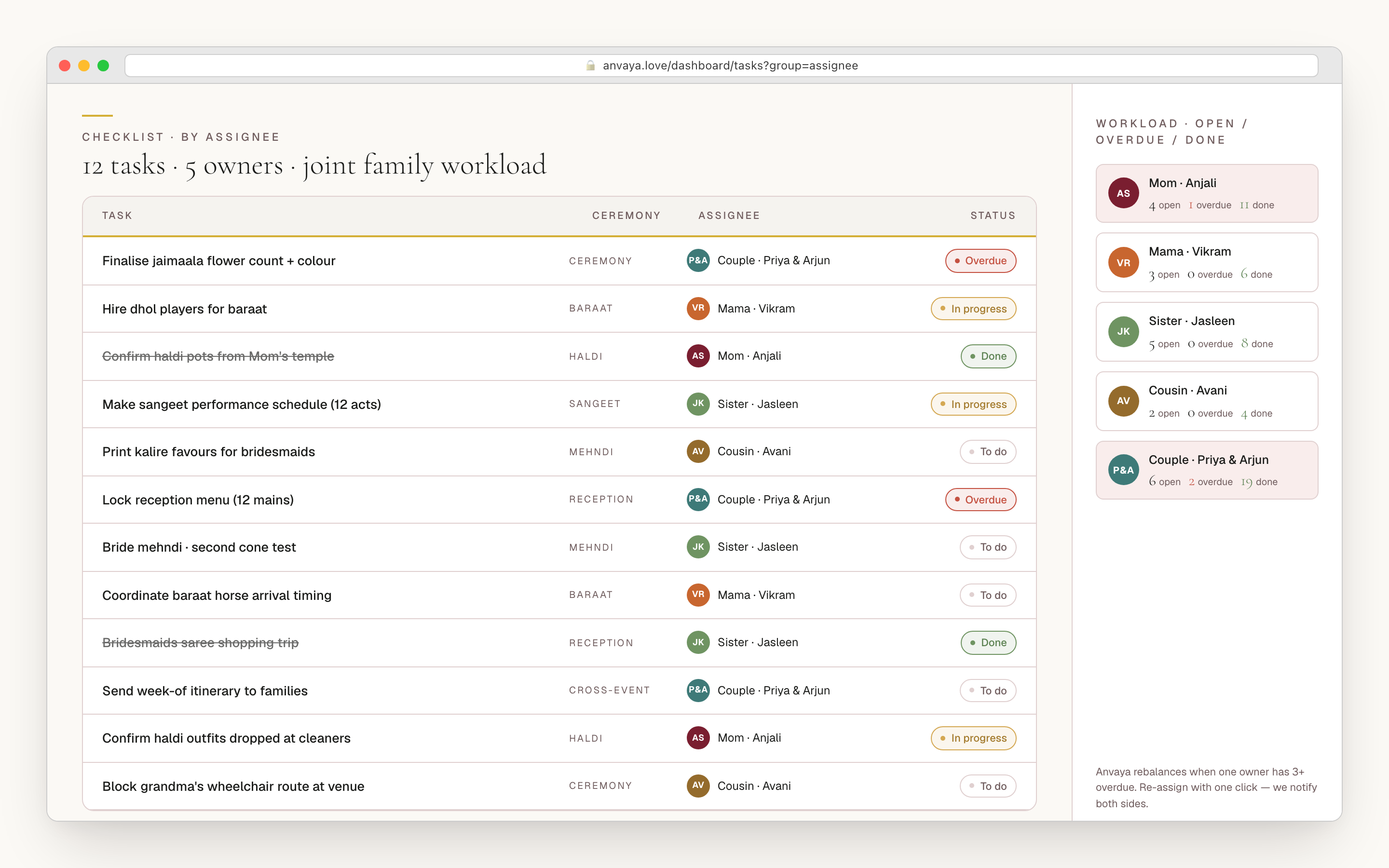
Assign each task to a specific, named member — not just “the couple.” Filter the board to one person and the cousin who owns decor sees exactly her list and nothing else. When the load has to move — mama is travelling, the maid-of-honour is buried — select a batch of tasks and reassign them in one action instead of reopening each one.
Four roles match how a family actually runs a wedding. Couple Primary does everything, including inviting and removing members. Family Admin (a parent, anyone running a major slice) can add, edit, and delete. Family Contributor (the cousin who owns one piece) creates and completes tasks but cannot delete them. Guest is read-only. Every change lands in the activity log — so when mom and the mother-in-law both think they confirmed the decorator, the timestamps settle it.
- Assign every task to a named family member — not just the couple
- Filter the board to one person so each owner sees only their list
- Select a batch of tasks and reassign them all in one action
- Four roles: Couple Primary, Family Admin, Family Contributor, Guest
- Contributors create and complete; deleting takes Admin or Primary
- The activity log records who changed what and when
FAQ
Questions we hear a lot
Multi-Event
Per-event guest lists, RSVP, seating, and vendors across every ceremony in your wedding.
Plan every eventAnvaya AI
A built-in AI chat that adds guests, snapshots the budget, and drafts messages with you — plus the same assistant inside Claude and ChatGPT.
Plan with Anvaya AIVendors
For existing accounts: extract quotes from vendor emails and compare vendors side by side.
Track vendorsOne checklist.
Six functions.
One family.
Free during early access. No credit card. Built for South Asian weddings.